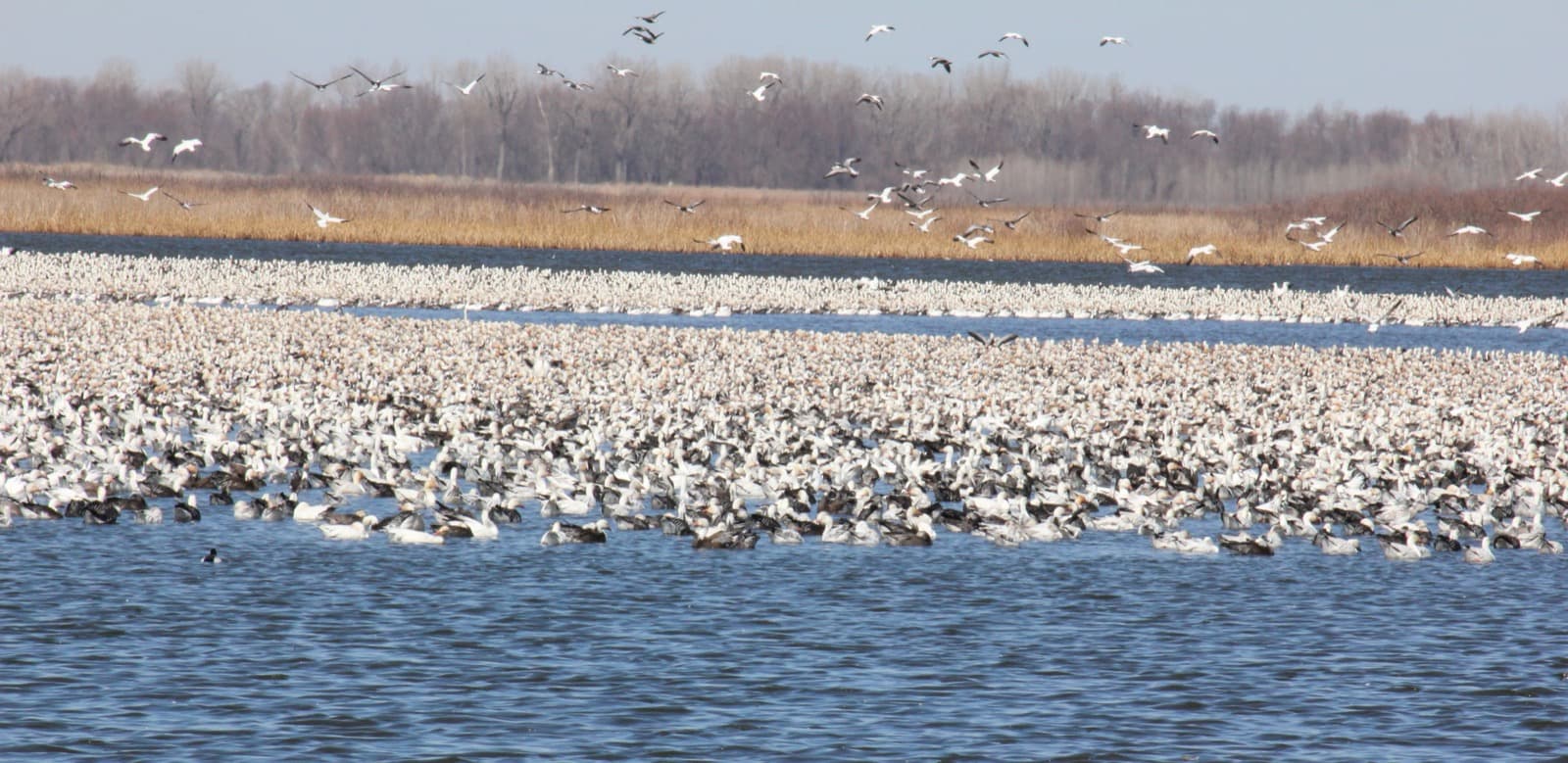
Mostly snow geese on the water at Loess Bluffs National Wildlife Refuge, March 25, 2014 (the refuge then had its former name). Photo: Bill O'Brian/USFWS · public domain · resized; cropped to fit. Not current conditions.
Loess Bluffs Refugespring migration
Spring snow geese begin to arrive in mid-February, with the peak in mid-March, per the Fish and Wildlife Service. Its usual window for this year has passed.
Loess Bluffs National Wildlife Refuge through the year
- Spring snow goose migration (arrive mid-February, peak mid-March)Feb–Mar
- Wildlife with youngJun–Aug
- Migrating waterfowl on their way southOct–Dec
- Fall snow geese (peak in mid to late November)Oct–Nov
- Bald eagles, best in December and January (migration peak usually by December 1)Dec–Jan
This week at Loess Bluffs Refuge
Right now in Loess Bluffs Refuge · September
Next usual spring migration timingfrom mid-February, peaking in mid-March, local timing
Next 7 days
Sat, Oct 3: Partly Sunny, high 68°F, low 53°F · 5% chance of rain
Sun, Oct 4: Sunny, high 70°F, low 51°F · 2% chance of rain
- Rain likely · up to 96% chanceTonight, Wednesday, Wednesday Night, Thursday, Thursday Night
Updated Tue, Sep 29, 12:22 PM CDT, source: National Weather Service.
Today here · Tue, Sep 29
Usual season: from mid-February, peaking in mid-March.
Sun: rises 7:16 a.m., sets 7:08 p.m.; civil twilight ends 7:35 p.m.
Moon tonight: waning gibbous, 86% lit (at 10 p.m.).
Sun and moon: our calculation, flat horizon. Window: U.S. Fish and Wildlife Service. How these work
Where to watch
- 10-mile auto tourStarts at the observation deck by the main entrance and loops 10 miles past wetlands, grasslands and forest, with spotting scopes along the drive; open daily from 30 minutes before sunrise to 30 minutes after sunset
- Loess Bluff TrailA moderately hard 0.8-mile trail from the visitor contact station through forest to the top of the bluffs, for a panoramic view of the refuge; the climb is 200 stone steps laid by hand by the Civilian Conservation Corps
Nearby
- Swan Lake Refuge111 miLocal timing: April and May · starts in ~6 monthsTuMostly Cloudy, rain likelyWeChance Showers And Thunderstorms, rain likelyThShowers And Thunderstorms, rain likelyFrChance Rain Showers, rain likelySaPartly SunnySuMostly SunnyMoSunny
- Port Louisa Refuge229 miLocal timing: April to May · starts in ~6 monthsTuPartly Sunny, rain likelyWeShowers And Thunderstorms, rain likelyThShowers And Thunderstorms, rain likelyFrRain Showers Likely, rain likelySaMostly SunnySuMostly SunnyMoSunny
- Trempealeau Refuge334 miLocal timing: late April or early May · starts in ~7 monthsTuRain Showers Likely, rain likelyWePatchy Fog then Mostly Cloudy, rain likelyThChance Rain Showers, rain likelyFrMostly SunnySaMostly SunnySuMostly SunnyMoSunny
- Necedah Refuge378 miLocal timing: May · starts in ~7 monthsTuSlight Chance Rain Showers, rain likelyWeChance Rain Showers, rain likelyThChance Rain Showers, rain likelyFrMostly SunnySaMostly SunnySuMostly SunnyMoSunny
Loess Bluffs Refuge in pictures
Questions people ask
When is the best time to see spring migration at Loess Bluffs National Wildlife Refuge?
Spring snow geese begin to arrive in mid-February, with the peak in mid-March, per the Fish and Wildlife Service: from mid-February, peaking in mid-March. That's general timing for this place, not a peak date or a forecast.
Is spring migration under way at Loess Bluffs National Wildlife Refuge right now?
Not now: its usual spring migration window for this year has passed. Next time: from mid-February, peaking in mid-March, local timing.
Is there a fee?
No, there is no charge to visit.Source: U.S. Fish and Wildlife Service, Loess Bluffs National Wildlife Refuge: Visit Us ↗ (opens in a new tab)
When is it open?
The auto tour, lands and trails are open daily, federal holidays included, from 30 minutes before sunrise to 30 minutes after sunset. The visitor contact station is open Tuesday to Saturday, 10 a.m. to 3 p.m., except federal holidays.Source: U.S. Fish and Wildlife Service, Loess Bluffs National Wildlife Refuge: Visit Us ↗ (opens in a new tab)
Are there spotting scopes?
Yes, at the visitor contact station, on the hiking trails and along the auto tour drive.Source: U.S. Fish and Wildlife Service, Loess Bluffs National Wildlife Refuge: Visit Us ↗ (opens in a new tab)
When is it busiest?
Friday through Sunday are the busiest days.Source: U.S. Fish and Wildlife Service, Loess Bluffs National Wildlife Refuge: Visit Us ↗ (opens in a new tab)
Is spring bigger than fall?
More snow geese use the refuge in spring, sometimes millions at a time; at the peak the wetland turns from blue to white.Source: U.S. Fish and Wildlife Service, Loess Bluffs National Wildlife Refuge: Species ↗ (opens in a new tab)
Where are the best spots in Loess Bluffs National Wildlife Refuge?
10-mile auto tour: starts at the observation deck by the main entrance and loops 10 miles past wetlands, grasslands and forest, with spotting scopes along the drive; open daily from 30 minutes before sunrise to 30 minutes after sunset; Loess Bluff Trail: a moderately hard 0.8-mile trail from the visitor contact station through forest to the top of the bluffs, for a panoramic view of the refuge; the climb is 200 stone steps laid by hand by the Civilian Conservation Corps.
What is Loess Bluffs National Wildlife Refuge like through the year?
Fall snow geese (peak in mid to late November) (Oct–Nov), Bald eagles, best in December and January (migration peak usually by December 1) (Dec–Jan), Migrating waterfowl on their way south (Oct–Dec), Spring snow goose migration (arrive mid-February, peak mid-March) (Feb–Mar) and Wildlife with young (Jun–Aug).
How we know
National Weather Service forecast and alerts (opens in a new tab) (Sep 29) · U.S. Fish and Wildlife Service, Loess Bluffs National Wildlife Refuge: Species (opens in a new tab) (Sep 28) · U.S. Fish and Wildlife Service, Loess Bluffs National Wildlife Refuge: Visit Us (opens in a new tab) (Sep 28)