Montana
When to catch Glacierat its best
Glacier through the year: wildflowers (local timing: between mid-June and mid-August) and fall foliage (local timing: by mid-September, and the western larch by mid-October). Each has its own page with spots, sources and the latest reports.
About Glacier
- What it is
- A national park in Montana
- What you'll see
- Wildflowers · Jun–AugFall foliage · Sep–Oct
- Before you go
- When do the wildflowers bloom at Logan Pass? Between mid-June and mid-August, in a fast succession of blooms during a short growing season.Is Going-to-the-Sun Road open in wildflower season? It's typically open to through traffic from late June to early October.Can I park at Logan Pass? Expect a crowd: the lot often fills before dawn and stays mostly full all day.
RIGHT NOW · SEP 30
- Latest reportNo dated report this season; the posters below show each usual window.
- This weekend (NWS)Sat patchy fog then sunny, 70°F · Sun sunny, 73°F
- Park alertsNo current NPS alerts
When are you going?
Fall at Glacier
- SEASON · FALL FOLIAGEGlacierBy mid-September, and the western larch by mid-OctoberMontana
By mid-September, and the western larch by mid-October · National Park Service ↗
Winter at Glacier
Good in winter
- Winter: ski and snowshoe routes for every skill level
From each place's own sources; no peak claimed.
Things to do in winter
- Gray Wolves ↗The subspecies of gray wolves (Canis lupus) found in Glacier is called the northern Rocky Mountain gray wolf (C. l. irremotus). There are three color variants: gray, white, and black. Wolves are secretive and elusive creatures, with sightings primarily being of lone wolves or pairs.
National Park Service, which lists these for winter; no peak claimed.
Spring at Glacier
Good in spring
- Going-to-the-Sun Road for hikers and bikers
From each place's own sources; no peak claimed.
Things to do in spring
- Gray Wolves ↗The subspecies of gray wolves (Canis lupus) found in Glacier is called the northern Rocky Mountain gray wolf (C. l. irremotus). There are three color variants: gray, white, and black. Wolves are secretive and elusive creatures, with sightings primarily being of lone wolves or pairs.
- Mountain Bluebird ↗The mountain bluebird is a small bird with a round head and a straight, thin bill. Adult males are bright sky-blue, somewhat paler underneath. Adult females have duller blue wings and tails with gray breasts, crowns, throats, and backs. Their call sounds similar to a thin “tew” while their song is a warbled high “chur chur.”
- Harlequin Duck ↗One-quarter of Montana’s harlequin duck broods are born in Glacier National Park. These birds have a low reproductive rate and are very susceptible to habitat loss and degradation. Because of these characteristics, they are listed as a Species of Concern in the state of Montana.
- Osprey ↗A large bird with a slim body, the osprey has long, narrow wings that have a sharp bend in flight resembling the letter “M.” Ospreys have dark-brown feathers on their back and are white underneath. They also have a notable dark mark at the “wrist” of their wing. An osprey’s call is high-pitched with a series of short, slightly wavering screeches that sound like “too-too-too-tee-tee-tee-tee-too-too.”
National Park Service, which lists these for spring; no peak claimed.
Summer at Glacier
- SEASON · WILDFLOWERSGlacierBetween mid-June and mid-AugustMontana
Between mid-June and mid-August · National Park Service ↗
Also good in summer
- Mountain Bluebird ↗The mountain bluebird is a small bird with a round head and a straight, thin bill. Adult males are bright sky-blue, somewhat paler underneath. Adult females have duller blue wings and tails with gray breasts, crowns, throats, and backs. Their call sounds similar to a thin “tew” while their song is a warbled high “chur chur.”
- Harlequin Duck ↗One-quarter of Montana’s harlequin duck broods are born in Glacier National Park. These birds have a low reproductive rate and are very susceptible to habitat loss and degradation. Because of these characteristics, they are listed as a Species of Concern in the state of Montana.
- Osprey ↗A large bird with a slim body, the osprey has long, narrow wings that have a sharp bend in flight resembling the letter “M.” Ospreys have dark-brown feathers on their back and are white underneath. They also have a notable dark mark at the “wrist” of their wing. An osprey’s call is high-pitched with a series of short, slightly wavering screeches that sound like “too-too-too-tee-tee-tee-tee-too-too.”
- Drive Going-to-the-Sun Road ↗A drive across this engineering marvel has been a quintessential part of any trip to Glacier since the 1930s.
From each place's own sources and the National Park Service; no peak claimed.
Where to go at Glacier
- Fall
Visitor points on this map: Rocky Point Trailhead (1.5 mi) · Apgar Lookout Trailhead (2 mi) · Apgar Visitor Center (0.4 mi) · West Glacier River Access Boating Site (1.6 mi)
Best spots
- Logan PassGood for wildflowersAlpine meadows with one quick bloom after another; no off-trail travel hereNational Park Service ↗
- Hidden Lake TrailGood for wildflowersWildflowers line the trail; the park bans off-trail walking hereNational Park Service ↗
- East-side aspen meadowsGood for wildflowersPurple asters between the aspen groves in late summerNational Park Service ↗
- Highway 2Good for fall foliageAlong the park's southern edge; sometimes the best road for larchNational Park Service ↗
- Going-to-the-Sun RoadGood for fall foliageUsually fully open until the third Monday in OctoberNational Park Service ↗
Next 7 days at Glacier
- TodayMostly Sunny62° / 37°4% rain
- ThuAreas Of Fog63° / 38°17% rain
- FriPatchy Fog then Mostly Sunny68° / 40°2% rain
- SatPatchy Fog then Sunny70° / 39°–
- SunSunny73° / 42°–
- MonMostly Sunny74° / 42°–
- TueSunny70° / 41°1% rain
Today: sunrise 7:35 a.m., sunset 7:19 p.m., light until 7:50 p.m. · moon waning gibbous, 77% lit (our calculation)
Visitor reports, not verified
Been here in the last week? Tell us how the trees looked.
What color were the trees?
Tap the one that looks most like what you saw.
One report per place for each day you saw it, no name or email · How reports work · Terms · Privacy
Plan your visit
Things to do
- BeaversThe North American beaver is the second largest rodent in the world behind the Capybara of South America. Found throughout the U.S. and Canada, these semiaquatic ecosystem engineers constuct dams and lodges that affect the hydrology and ecology of their surroundings. As a keystone species, their presence in riparian habitats affects all neighboring animal and plant life.
- WolverinesA mid-sized carnivore in the weasel family, the wolverine is active throughout the year in cold, snowy environments to which it is well-adapted. Wolverines are rarely seen and inhabit remote terrain. They are also known as one of the rarest and most elusive carnivores on the planet.
- Mountain GoatsThe mountain goat is one of the park's most inconic creatures. It is the only living member of its genus and is more closely related to caprines (the chamois of Europe and the gorals and serows of Asia) than to domesticated goats.
- Listen to Glacier's PodcastRangers recommend Glacier's podcast, Headwaters: a podcast about how Glacier is connected to everything else!
- Red FoxesRed foxes are found throughout the northern hemisphere. In Glacier, they are adapted to a wide range of habitats, from open grasslands to dense forests. Most abundant in riparian areas and along the edges of forests, they are the smallest of the canids found in the park. Red foxes occur in several color phases, but they usually have reddish-yellow coats that are somewhat darker on the back and shoulders, black "socks" on their lower legs, and a white-tipped tail.
- Gray WolvesThe subspecies of gray wolves (Canis lupus) found in Glacier is called the northern Rocky Mountain gray wolf (C. l. irremotus). There are three color variants: gray, white, and black. Wolves are secretive and elusive creatures, with sightings primarily being of lone wolves or pairs.
- ElkGlacier provides a summer range for a significant number of elk, while most winter at lower elevations outside the park. The subspecies occuring in Glacier is the Rocky Mountain elk (C. c. nelsoni). They feed on grasses, sedges, other herbs and shrubs, bark of aspen trees, conifer needles, burned bark, and aquatic plants.
- DeerTwo types of deer are commonly seen thorughout Glacier: the northwestern white-tailed deer (O. v. ochrourus) and the Rocky Mountain mule deer (O. h. hemionus). Both will flee when in danger. Males grow antlers from April or May through August or September and then shed them in the spring.
- All about birding in Glacier National ParkGlacier provides a wonderful opportunity to birdwatch, with plenty of spaces for birders of all ages to sit, listen, and observe the sights and sounds of nature. With 279 documented species including raptors, songbirds, shorebirds, and waterfowl, the park’s variation in elevation and habitat types contribute to a high diversity of bird life.
- White-Tailed PtarmiganThe white-tailed ptarmigan is a medium to large chicken-like member of the grouse family. They are completely white in winter and barred grayish-brown in summer with white wings and tails and feathered feet. Breeding males will have a broad band of black markings across the chest and have red eye combs. Like chickens, they make clucking noises.
- Mountain BluebirdThe mountain bluebird is a small bird with a round head and a straight, thin bill. Adult males are bright sky-blue, somewhat paler underneath. Adult females have duller blue wings and tails with gray breasts, crowns, throats, and backs. Their call sounds similar to a thin “tew” while their song is a warbled high “chur chur.”
- Clark's NutcrackerThe Clark’s nutcracker has a pale- gray body, black wings with large white patches along the trailing edges, and a black tail with broad white stripes on either side. These birds typically travel in small flocks and call back and forth to communicate. They have a long, harsh, rising call that sounds similar to “shraaaaaaa.”
Towns nearby
- Missoula, MT114 mi
- Coeur d'Alene, ID141 mi
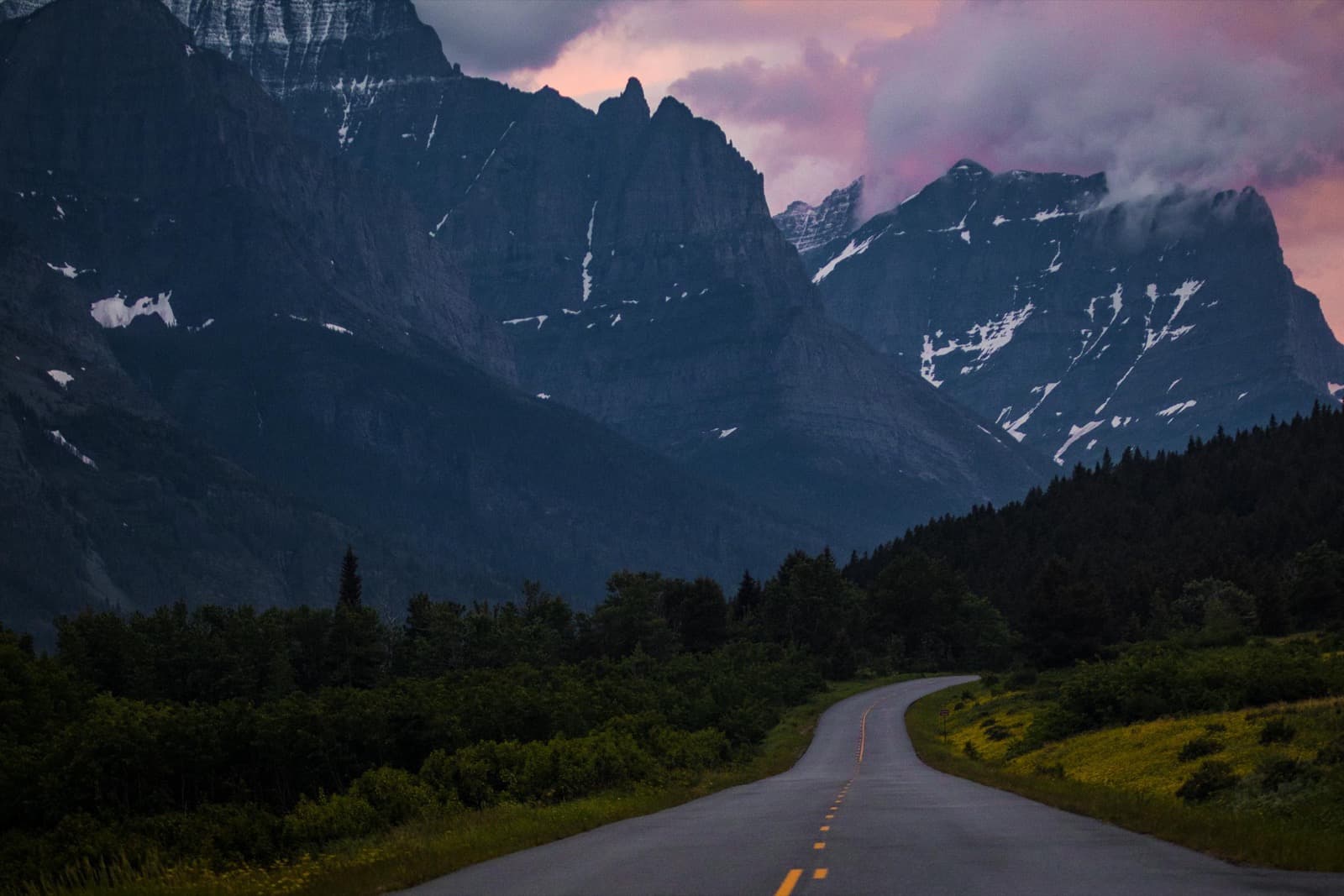
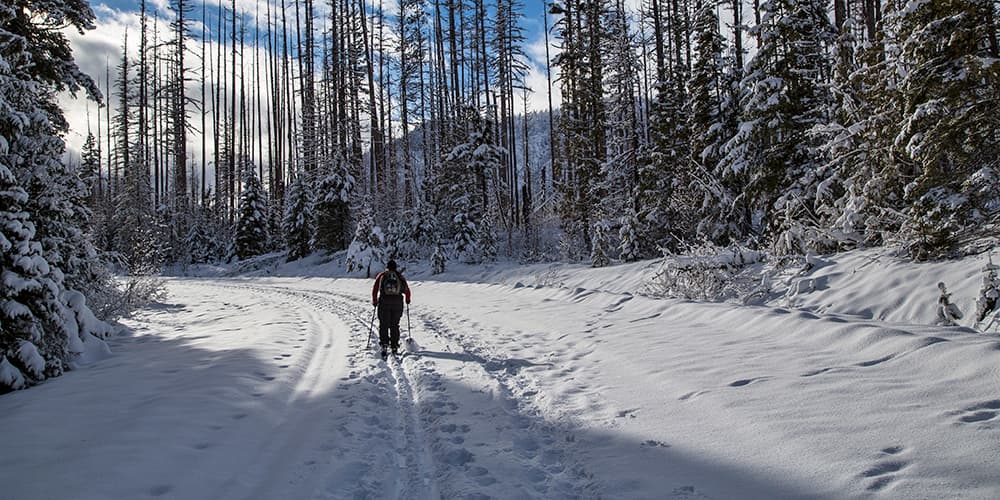
Glacier in pictures
Questions people ask
When do the wildflowers bloom at Logan Pass?
Between mid-June and mid-August, in a fast succession of blooms during a short growing season.Source: National Park Service, Glacier photo tips ↗ (opens in a new tab)
What will I see?
Beargrass and whole fields of glacier lilies in the subalpine, and purple asters on the east side late in summer. The park has nearly a thousand wildflower species.Source: National Park Service, Glacier wildflowers ↗ (opens in a new tab)
Is Going-to-the-Sun Road open in wildflower season?
It's typically open to through traffic from late June to early October.Source: National Park Service, Visiting Logan Pass in 2026 (FAQ) ↗ (opens in a new tab)
Can I park at Logan Pass?
Expect a crowd: the lot often fills before dawn and stays mostly full all day.Sources: National Park Service, Visiting Logan Pass in 2026 (FAQ) ↗ (opens in a new tab), National Park Service, Glacier photo tips ↗ (opens in a new tab)
How we know
- Sep 27Park ServiceLogan Pass wildflowers between mid-June and mid-August; no off-trail travel in its alpine meadowsSource (opens National Park Service, Glacier photo tips in a new tab)
- Sep 27Park ServiceTrees turning by mid-September, western larch last in mid-October; Going-to-the-Sun Road and service seasonsSource (opens National Park Service, Glacier operating hours and seasons in a new tab)
- National Park Service sources: no claim to original U.S. Government works.