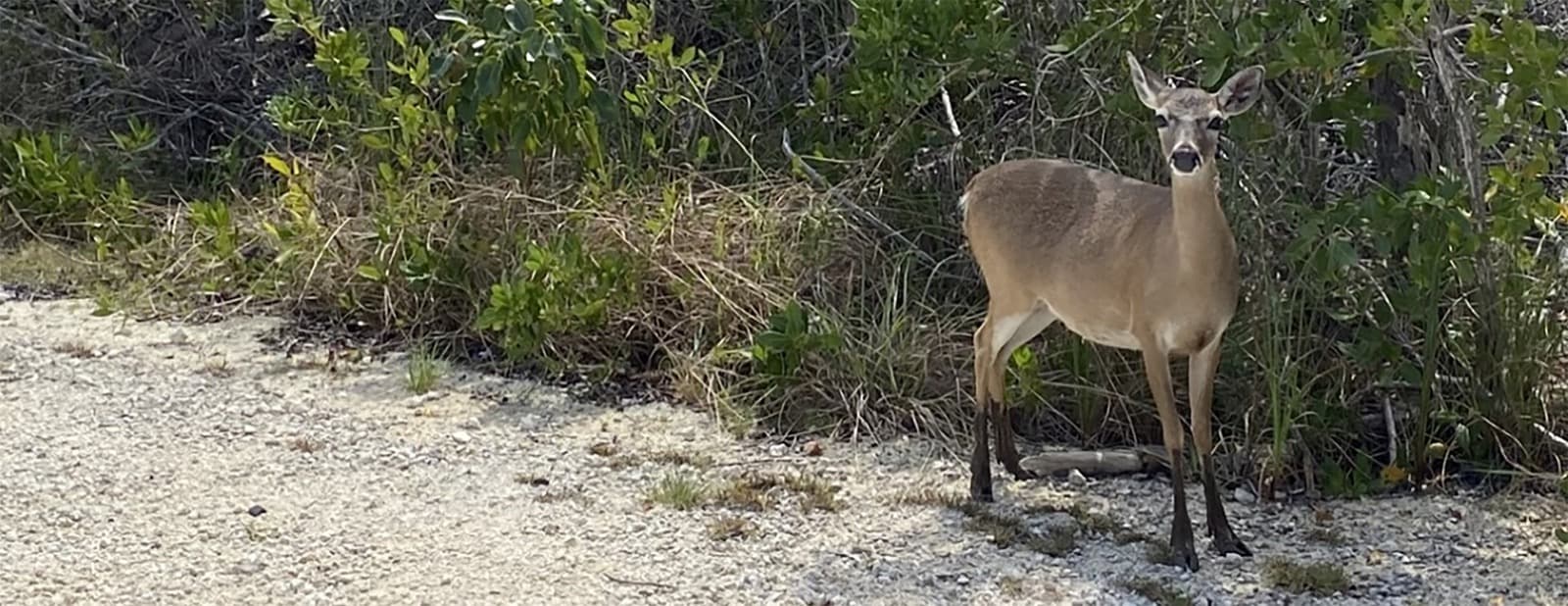
Key deer on No Name Key, Florida (2022). Photo: Dan Chapman/USFWS · public domain · resized; cropped to fit. Not current conditions.
National Key Deer Refugewildlife
At National Key Deer Refuge, the timing for wildlife comes in 3 separate phases, each its own display, none of them a peak: Key deer fawning season, May and June; Bucks in velvet, fawns still being born, July and August; and Key deer rut begins, September and October. No official report yet this season.
National Key Deer Refuge through the year
- Wintering white pelicans and wading birds fish in the salt ponds (January and February)Jan–Feb
- Neotropical migrant birds: peak northbound migration (March and April)Mar–Apr
- Bartram's hairstreak butterflies at their peak in the pine rockland (March and April)Mar–Apr
- Key deer: peak fawning season, fawns with spots (May and June)May–Jun
- Green herons, and possibly anhingas, nesting at Blue Hole (May and June)May–Jun
- Key deer bucks' antlers growing in velvet; fawns still being born (July and August)Jul–Aug
- Key deer rut (breeding season) begins (September and October)NowSep–Oct
- Peak fall southbound bird migration, with migrating peregrine falcons (September and October)NowSep–Oct
- May–JuneKey deer fawning seasonMay and June
- July–AugustBucks in velvet, fawns still being bornJuly and August
- September–OctoberKey deer rut beginsSeptember and October
This week at National Key Deer Refuge
Next 7 days
Sat, Oct 3: Chance Showers And Thunderstorms, high 90°F, low 79°F · 36% chance of rain
Sun, Oct 4: Slight Chance Showers And Thunderstorms, high 89°F, low 79°F · 23% chance of rain
- Rain likely · up to 74% chanceThis Afternoon, Tonight, Wednesday, Wednesday Night, Thursday, Thursday Night, Friday
Updated Tue, Sep 29, 1:23 PM EDT, source: National Weather Service.
Today here · Tue, Sep 29
Sun: rises 7:17 a.m., sets 7:16 p.m.; civil twilight ends 7:38 p.m.
Moon tonight: waning gibbous, 87% lit (at 10 p.m.).
Sun and moon: our calculation, flat horizon. How these work
Where to watch
- No Name Key trailsRustic fire-road trails running south from Watson Rd/Old State Rd 4A, east of Big Pine Key, through shaded hardwood hammock and pine rockland; surfaces are uneven, poisonwood may overhang, and bikes are allowed on rough terrain. Big Pine and No Name Keys hold about 75% of the Key deer
- Blue Hole Observation PlatformThree miles north of US 1 on Key Deer Boulevard: a short, shaded paved trail from the parking lot to a platform over a former limestone quarry, now a freshwater pond; accessible to everyone, no bikes on the trail
Nearby
- St. Marks Refuge415 mi3 separate phases, from May · starts soonTuSunnyWeSunny then Slight Chance Showers And Thunderstorms, rain likelyThMostly Sunny then Slight Chance Showers And Thunderstorms, rain likelyFrChance Showers And Thunderstorms, rain likelySaChance Showers And Thunderstorms, rain likelySuChance Showers And Thunderstorms, rain likelyMoShowers And Thunderstorms Likely, rain likely
- Carolina Sandhills Refuge683 mi3 separate phases, from April through OctoberTuSunnyWePatchy Fog then SunnyThSunnyFrSunny, rain likelySaSlight Chance Rain Showers then Chance Showers And Thunderstorms, rain likelySuShowers And Thunderstorms Likely, rain likelyMoChance Rain Showers, rain likely
- Attwater Prairie Chicken Refuge978 miLocal timing: late February through early April · starts in ~5 months
- Padre Island National Seashore1007 miAt one spot: mid-June through August · starts in ~9 months
National Key Deer Refuge in pictures
Questions people ask
When is the best time to see wildlife at National Key Deer Refuge?
In 3 separate phases: Key deer fawning season, May and June, Bucks in velvet, fawns still being born, July and August and Key deer rut begins, September and October. They're separate displays, not one long season, and none of them is a peak.
Is it the season at National Key Deer Refuge right now?
There's no official report yet this season.
When is the best time of day to see Key deer?
Early morning or toward sunset, although they're sometimes seen at midday. They roam freely across refuge lands and the surrounding neighborhoods.Source: U.S. Fish and Wildlife Service, National Key Deer Refuge: Visit Us ↗ (opens in a new tab)
Can I feed the deer or walk up to them?
Please don't feed them: feeding has taught many deer to approach people, which is unhealthy for them. Use binoculars or a telephoto lens to get a close look.Source: U.S. Fish and Wildlife Service, National Key Deer Refuge (Seasons of Wildlife) ↗ (opens in a new tab)
What should drivers know?
Drive carefully in Key deer country, from Big Pine and No Name Keys west to Lower Sugarloaf Key, especially at night when the deer are more active, and pull your car completely off the road to watch wildlife.Sources: U.S. Fish and Wildlife Service, National Key Deer Refuge (Seasons of Wildlife) ↗ (opens in a new tab), U.S. Fish and Wildlife Service, National Key Deer Refuge: Visit Us ↗ (opens in a new tab)
What if I see an injured deer?
Call the Florida FWC Wildlife Hotline Dispatch at 888-404-FWCC (3922), option 1, to report a dead or seriously injured Key deer.Source: U.S. Fish and Wildlife Service, National Key Deer Refuge (Seasons of Wildlife) ↗ (opens in a new tab)
When are refuge lands open?
From half an hour before sunrise to half an hour after sunset. The Nature Center on Big Pine Key is open Wednesday to Saturday, 10 a.m. to 3 p.m.Sources: U.S. Fish and Wildlife Service, National Key Deer Refuge: Visit Us ↗ (opens in a new tab), U.S. Fish and Wildlife Service, National Key Deer Refuge (Seasons of Wildlife) ↗ (opens in a new tab)
Where are the best spots in National Key Deer Refuge?
No Name Key trails: rustic fire-road trails running south from Watson Rd/Old State Rd 4A, east of Big Pine Key, through shaded hardwood hammock and pine rockland; surfaces are uneven, poisonwood may overhang, and bikes are allowed on rough terrain. Big Pine and No Name Keys hold about 75% of the Key deer; Blue Hole Observation Platform: three miles north of US 1 on Key Deer Boulevard: a short, shaded paved trail from the parking lot to a platform over a former limestone quarry, now a freshwater pond; accessible to everyone, no bikes on the trail.
What is National Key Deer Refuge like through the year?
Neotropical migrant birds: peak northbound migration (March and April) (Mar–Apr), Bartram's hairstreak butterflies at their peak in the pine rockland (March and April) (Mar–Apr), Key deer: peak fawning season, fawns with spots (May and June) (May–Jun), Key deer rut (breeding season) begins (September and October) (Sep–Oct), Peak fall southbound bird migration, with migrating peregrine falcons (September and October) (Sep–Oct), Wintering white pelicans and wading birds fish in the salt ponds (January and February) (Jan–Feb), Key deer bucks' antlers growing in velvet; fawns still being born (July and August) (Jul–Aug) and Green herons, and possibly anhingas, nesting at Blue Hole (May and June) (May–Jun).
How we know
U.S. Fish and Wildlife Service, National Key Deer Refuge (Seasons of Wildlife) (opens in a new tab) (Sep 29) · U.S. Fish and Wildlife Service, National Key Deer Refuge: Visit Us (opens in a new tab) (Sep 29) · National Weather Service forecast and alerts (opens in a new tab) (Sep 29)