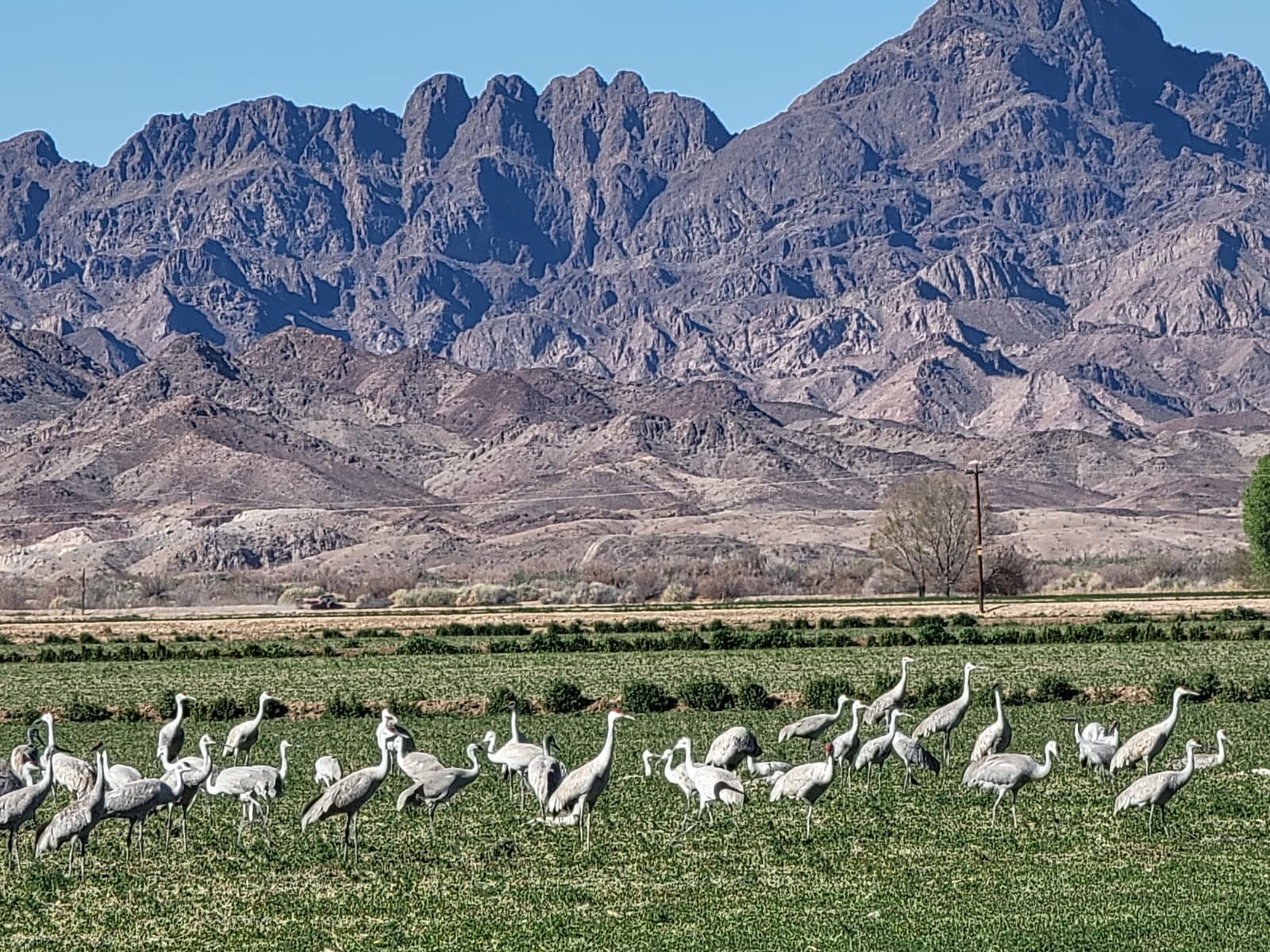
Sandhill cranes in a green field at Cibola National Wildlife Refuge, below the desert mountains (the item page gives no date). Photo: Linda L Miller/USFWS · public domain · resized; cropped to fit. Not current conditions.
Cibola Refugewinter wildlife
At Cibola National Wildlife Refuge, the timing for winter wildlife comes in 3 separate phases, each its own display, none of them a peak: Early fall migration: shorebirds and flycatchers, mid-July to mid-September; Fall migration: most waterfowl and sparrows, September to November; and Wintering sandhill cranes, December to February. No official report yet this season.
Cibola National Wildlife Refuge through the year
- Early fall migration for shorebirds and flycatchers, mid-July to mid-SeptemberNowJul–Sep
- Fall migration for most waterfowl and sparrows, September to NovemberNowSep–Nov
- Western Canada geese: listed as abundant in fall and winter, September–February (refuge bird checklist, 2016)NowSep–Feb
- Cibola Lake closed to all entry, October 1 to March 14Oct–Mar
- Visitor center open daily, November 20 to March 31Nov–Mar
- Wintering sandhill cranes, December–February (refuge bird checklist, 2016)Dec–Feb
- July–SeptemberEarly fall migration: shorebirds and flycatchersmid-July to mid-September
- September–NovemberFall migration: most waterfowl and sparrowsSeptember to November
- December–FebruaryWintering sandhill cranesDecember to February
This week at Cibola Refuge
Where to watch
- Hart Mine Marsh UnitOne of the wetlands the refuge fills with Colorado River water for its fall and winter birds, and a favorite place to watch wildlife. Open daily sunrise to sunset from March 15 to September 30, but only 10 a.m. to 3 p.m. from October 1 to March 14.
- Goose Loop Auto TourThe refuge's drive, open year-round from 30 minutes before sunrise to 30 minutes after sunset. The easy 1-mile gravel Nature Trail starts at the parking lot near the start of the loop and passes through cottonwood, willow and mesquite to an observation platform.
Nearby
- Merced Refuge427 miLocal timing: mid-September to early MarchTuSunnyWeSunnyThSunnyFrSunnySaSunnySuSunnyMoSunny
- San Luis Refuge444 miLocal timing: January · starts in ~3 monthsTuSunnyWeSunnyThSunnyFrSunnySaSunnySuSunnyMoSunny
- Bosque del Apache Refuge449 miLocal timing: late October through late January · starts soonTuShowers And Thunderstorms, rain likelyWeMostly Sunny then Chance Showers And Thunderstorms, rain likelyThSunnyFrSunnySaSunnySuSunnyMoSunny
- Fish Springs Refuge453 miLocal timing: mid-October into January · starts soonTuMostly Sunny, wind to 21 mphWeSunnyThSunnyFrSunnySaSunnySuSunnyMoSunny
Cibola Refuge in pictures
Questions people ask
When is the best time to see winter wildlife at Cibola National Wildlife Refuge?
In 3 separate phases: Early fall migration: shorebirds and flycatchers, mid-July to mid-September, Fall migration: most waterfowl and sparrows, September to November and Wintering sandhill cranes, December to February. They're separate displays, not one long season, and none of them is a peak.
Is it wildlife season at Cibola National Wildlife Refuge right now?
There's no official report yet this season.
Is there an entrance fee?
No. There is no charge to visit the refuge.Source: U.S. Fish and Wildlife Service, Cibola NWR: Visit Us ↗ (opens in a new tab)
Can I visit Cibola Lake in winter?
No. Cibola Lake is closed to all entry from October 1 to March 14. From March 15 to September 30 it's open sunrise to sunset.Source: U.S. Fish and Wildlife Service, Cibola NWR: Visit Us ↗ (opens in a new tab)
When is the visitor center open?
Every day from 8 a.m. to 4 p.m. between November 20 and March 31, closed on federal holidays. Refuge lands, roads and trails are open daily from sunrise to sunset.Source: U.S. Fish and Wildlife Service, Cibola NWR: Visit Us ↗ (opens in a new tab)
What should I bring?
Plenty of drinking water, snacks, insect repellent and sunscreen. Summer temperatures can be extreme, while winters are mild to moderate. Binoculars help, and dawn and dusk are the best times to see wildlife.Source: U.S. Fish and Wildlife Service, Cibola NWR: Visit Us ↗ (opens in a new tab)
Are there restrooms?
Yes: at the refuge headquarters, next to the front entrance, and comfort stations at the Nature Trail, Island Unit and Unit 2 parking areas.Source: U.S. Fish and Wildlife Service, Cibola NWR: Visit Us ↗ (opens in a new tab)
Will the wetlands have water this season?
As of September 2026, the refuge's latest water note (its 2025 update) says drought makes keeping enough water on the refuge a constant challenge: its pumps can only run when the Colorado River is at a safe level, and the Bureau of Reclamation expected the lowest river flows from November through February. In the refuge's words, much depends on how high or low the river runs.Source: U.S. Fish and Wildlife Service, Cibola NWR: Visit Us ↗ (opens in a new tab)
Where are the best spots in Cibola National Wildlife Refuge?
Hart Mine Marsh Unit: one of the wetlands the refuge fills with Colorado River water for its fall and winter birds, and a favorite place to watch wildlife. Open daily sunrise to sunset from March 15 to September 30, but only 10 a.m. to 3 p.m. from October 1 to March 14.; Goose Loop Auto Tour: the refuge's drive, open year-round from 30 minutes before sunrise to 30 minutes after sunset. The easy 1-mile gravel Nature Trail starts at the parking lot near the start of the loop and passes through cottonwood, willow and mesquite to an observation platform..
Are there closures or permits to know about in Cibola National Wildlife Refuge?
Cibola Lake closed to all entry, October 1 to March 14 (Oct–Mar).
What is Cibola National Wildlife Refuge like through the year?
Wintering sandhill cranes, December–February (refuge bird checklist, 2016) (Dec–Feb), Western Canada geese: listed as abundant in fall and winter, September–February (refuge bird checklist, 2016) (Sep–Feb), Early fall migration for shorebirds and flycatchers, mid-July to mid-September (Jul–Sep), Fall migration for most waterfowl and sparrows, September to November (Sep–Nov), Visitor center open daily, November 20 to March 31 (Nov–Mar) and Cibola Lake closed to all entry, October 1 to March 14 (Oct–Mar).
How we know
U.S. Fish and Wildlife Service, Birds of Cibola National Wildlife Refuge (checklist, through July 2016) (opens in a new tab) (Sep 29) · U.S. Fish and Wildlife Service, Cibola NWR: Visit Us (opens in a new tab) (Sep 29)