When do northern red oaksturn?
When do northern red oaks change color?
New England sees northern red oaks at their most colorful first, around Oct 27–Nov 2; the Mid-Atlantic last, around Nov 10–16, 2 weeks later (USA-NPN, 2020–2025).
One tree, several regions
- New England9th of 10 to color · most Oct 27–Nov 2
- The Southern Appalachians10th of 10 to color · most Nov 10–16
- The Mid-Atlantic9th of 10 to color · most Nov 10–16
Sep 1 to Nov 30; darker = more northern red oaks half colored.
How to recognize it
Its fall color. Russet, brown or deep red.
Leaf drawing: ours, simplified.
Sources: US Forest Service, Fall Colors ↗ (opens in a new tab), US Forest Service, Fire Effects Information System: northern red oak ↗ (opens in a new tab)
Look-alikes How to tell them apart (US Forest Service)
Look at the acorns: northern red oak's sit in a shallow, saucer-shaped cup and have a bitter kernel; white oak's sit in a rough, warty cup covering a third to half of the nut and have been called sweet. The bark differs too: red oak's is gray with shallow furrows and low ridges, turning checkered; white oak's is rough and scaly. Red oak is the tallest and fastest-growing oak, while white oak grows slowly and can live 600 years. Gray squirrels prefer red oak acorns; white-footed mice seem to like them less than white oak's.
When do white oaks turn? →Sources: US Forest Service, Fire Effects Information System: northern red oak ↗ (opens in a new tab), US Forest Service, Fire Effects Information System: white oak ↗ (opens in a new tab)
Where it grows
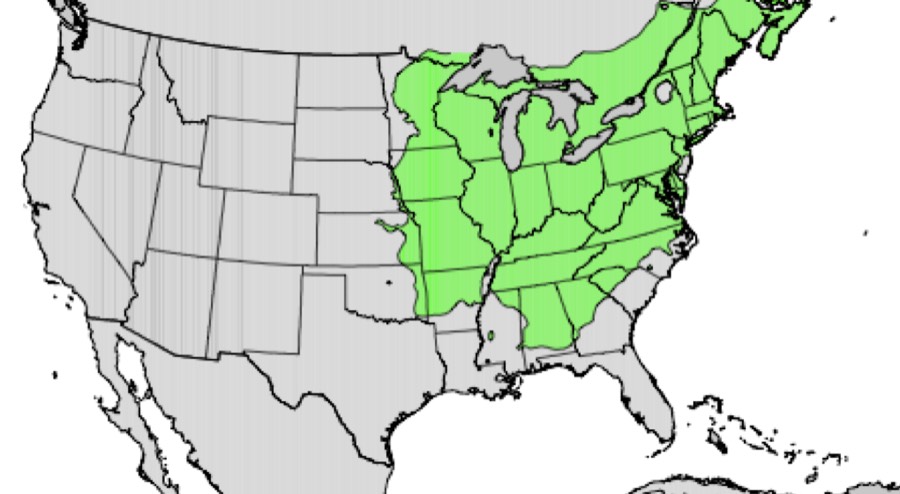
Sources: USDA Forest Service, Fire Effects Information System: Little's range maps ↗ (opens in a new tab), US Forest Service, Fire Effects Information System: northern red oak ↗ (opens in a new tab)
The northern red oak, in short
- Size
- The tallest and fastest-growing oak: commonly 65 to 98 feet tall with a trunk 2 to 3 feet across, and on the best sites up to 160 feet and 8 feet across.
- Lifespan
- Usually first bears acorns at about 25, but most trees don't produce them in quantity until about 50.
- Bark and fruit
- Gray to grayish-brown with shallow furrows and low ridges, becoming checkered with age. Acorns 0.8 to 1.3 inches long in a shallow, saucer-shaped cup, with a large, white, bitter kernel.
- Where it grows best
- Medium-moist to moderately dry sites: rich woods, sandy plains and rock outcrops, most often on north- and east-facing slopes, lower and middle slopes, coves, ravines and valley floors. Best on deep, fertile, well-drained soil; it grows best of all in the Ohio Valley and on the west slope of the Alleghenies.
- Shade
- In between: it can't get started under its own canopy.
- Wildlife
- Its acorns feed white-footed mice, chipmunks, squirrels, deer, black bears and many birds, and are especially important to wild turkeys. Gray squirrels prefer them to other oaks' acorns, and a good fall crop can affect how well black bears breed the next year. Deer browse the leaves and seedlings, and woodpeckers such as the red-bellied and hairy nest in the trees.
- People and uses
- A popular shade tree in eastern North America and parts of Europe, first grown in 1724. Many Native American peoples leached its acorns with ashes to take out the bitter tannins before cooking.
Source: US Forest Service, Fire Effects Information System: northern red oak ↗ (opens in a new tab)
Where to see northern red oaks in fall
- Katahdin Woods and Waters · MaineSep 1–Oct 15
- Aroostook Refuge · MaineUsually Oct 1–10
- Blue Ridge Parkway · North CarolinaUsually Oct 1–31
- Cumberland Gap · KentuckyOct 1–31
- Great Smoky Mountains · TennesseeUsually Oct 1–Nov 10
- Iroquois Refuge · New YorkOct 1–10
- Allegheny National Forest · PennsylvaniaOct 8–14
- Aroostook State Park · MaineOct 8–14
- Bradbury Mountain State Park · MaineOct 8–14
- Camden Hills State Park · MaineOct 8–14
- Ferry Beach State Park · MaineOct 8–14
- Grafton Notch State Park · MaineOct 8–14
States: Massachusetts · Maine · Rhode Island · Tennessee · North Carolina · Kentucky · New York · New Jersey · Pennsylvania
Questions people ask
When do northern red oaks turn?
It depends on the region. In a typical fall they are most colorful first in New England (week of Oct 27) and last in the Mid-Atlantic (week of Nov 10), from USA-NPN volunteer observations.
Do northern red oaks turn early or late compared with other trees?
In New England, number 9 of 10 trees to start coloring; In the Southern Appalachians, number 10 of 10 trees to start coloring; In the Mid-Atlantic, number 9 of 10 trees to start coloring.