When do American beechesturn?
When do American beeches change color?
New England sees American beeches at their most colorful first, around Oct 20–26; the Mid-Atlantic last, around Nov 3–9, 2 weeks later (USA-NPN, 2020–2025).
One tree, several regions
Sep 1 to Nov 30; darker = more American beeches half colored.
American beeches this fall
- New England about typical: 4% vs 0% (47 obs.)
How to recognize it
Its fall color. Soft bronze.
Leaves. Yellow-green through the growing season; the interlocking leaves on stout branches make a dense crown.
Leaf drawing: ours, simplified.
Sources: US Forest Service, Fall Colors ↗ (opens in a new tab), US Forest Service, Fire Effects Information System: American beech ↗ (opens in a new tab)
Where it grows
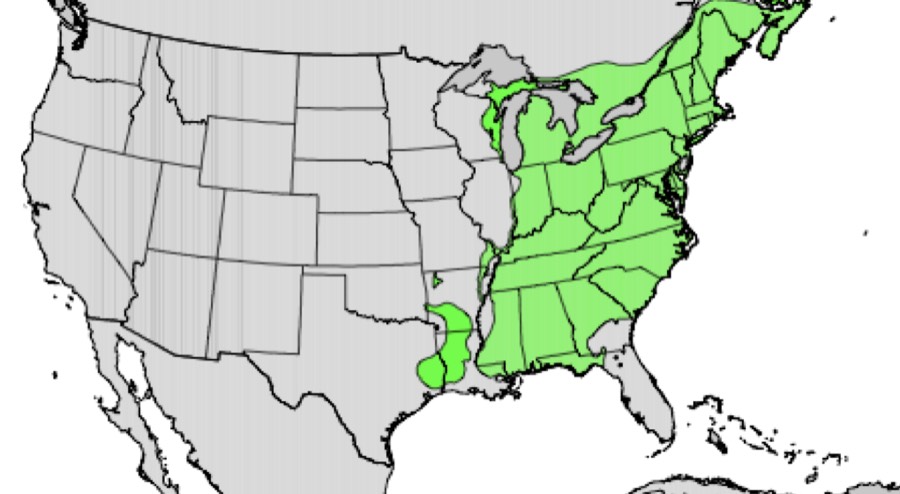
Sources: USDA Forest Service, Fire Effects Information System: Little's range maps ↗ (opens in a new tab), US Forest Service, Fire Effects Information System: American beech ↗ (opens in a new tab)
The American beech, in short
- Size
- Normally 65 to 80 feet tall, sometimes up to 130 feet, with stout branches and a dense crown.
- Lifespan
- Can live more than 300 years; it starts bearing nuts at about 40 and can produce big crops by 60.
- Bark and fruit
- Blue-gray. The fruit is a bur, usually holding two nuts.
- Where it grows best
- Low elevations in the North, higher in the South: cold and wind keep it below about 3,200 feet in the Adirondacks, while in the Appalachians it climbs to about 6,000 feet. In the middle of its range it prefers cool, moist north slopes, and it is seldom on limestone soils except at its western edge.
- Shade
- A climax tree: it grows slowly under conifers or hardwoods and rises when an opening appears. In an old-growth New Hampshire forest it replaced yellow birch and sugar maple and then kept itself going by root suckers.
- Wildlife
- Beechnuts feed mice, squirrels, chipmunks, black bears, deer, foxes, ruffed grouse, ducks and blue jays. Deer browse it mostly when better food is scarce.
- People and uses
- Beechnuts are roasted and eaten or used as a coffee substitute; the leaves and bark make dyes.
Source: US Forest Service, Fire Effects Information System: American beech ↗ (opens in a new tab)
Where to see American beeches in fall
- Iroquois Refuge · New YorkOct 1–10
- Crawford Notch and Zealand Valley · New HampshireOct 4–10
- White Mountain National Forest · New HampshireOct 4–10
- Pinkham Notch · New HampshireOct 4–10
- Waterville Valley · New HampshireOct 4–10
- Allegheny National Forest · PennsylvaniaOct 8–14
- Assabet River Refuge · MassachusettsUsually Oct 11–20
- Erie Refuge · PennsylvaniaUsually Oct 11–20
- Fort River Division · MassachusettsUsually Oct 11–20
- Great Bay Refuge · New HampshireOct 11–20
- McKinney Refuge · ConnecticutUsually Oct 11–31
- Parker River Refuge · MassachusettsOct 11–31
States: New Hampshire · Massachusetts · Connecticut · New York · Maryland · Pennsylvania
Questions people ask
When do American beeches turn?
It depends on the region. In a typical fall they are most colorful first in New England (week of Oct 20) and last in the Mid-Atlantic (week of Nov 3), from USA-NPN volunteer observations.
Do American beeches turn early or late compared with other trees?
In New England, number 6 of 10 trees to start coloring; In the Mid-Atlantic, number 10 of 10 trees to start coloring.
Are American beeches ahead or behind this fall?
In New England, for Sep 15–21: 4% of observations with half the leaves colored, against 0% in a typical year (about the same).