When do river birchesturn?
When do river birches change color?
The Upper Midwest sees river birches at their most colorful first, around Oct 27–Nov 2; the Mid-Atlantic last, around Nov 3–9, 1 week later (USA-NPN, 2020–2025).
One tree, several regions
- The Mid-Atlantic8th of 10 to color · most Nov 3–9
- The Upper Midwest9th of 10 to color · most Oct 27–Nov 2
Sep 1 to Nov 30; darker = more river birches half colored.
River birches this fall
- The Upper Midwest ahead: 5% vs 0% (22 obs.)
How to recognize it
Leaf drawing: ours, simplified.
Source: US Forest Service, Fire Effects Information System: river birch ↗ (opens in a new tab)
Look-alikes How to tell them apart (US Forest Service)
River birch's bark splits into thin papery scales, coarser low on the trunk; paper birch's mature bark is white and smooth and peels off in sheets. River birch keeps to floodplains, stream banks and sandbars, often on soil too acid for most hardwoods; paper birch grows on almost any soil, up to the Arctic tree line.
When do paper birches turn? →Sources: US Forest Service, Fire Effects Information System: river birch ↗ (opens in a new tab), US Forest Service, Fire Effects Information System: paper birch ↗ (opens in a new tab)
Where it grows
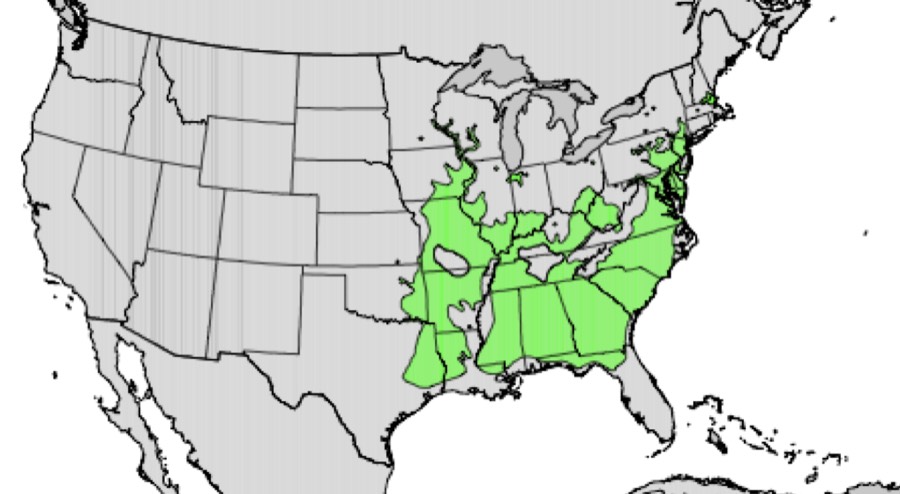
Sources: USDA Forest Service, Fire Effects Information System: Little's range maps ↗ (opens in a new tab), US Forest Service, Fire Effects Information System: river birch ↗ (opens in a new tab)
The river birch, in short
- Size
- Usually 50 to 80 feet tall with a trunk 24 to 36 inches across; single trees have reached 100 feet. In Wisconsin it is usually a small tree with several stems.
- Lifespan
- Fairly short-lived.
- Bark and fruit
- Splits into thin papery scales, coarser low on the trunk.
- Where it grows best
- A tree of floodplains, stream banks, lake edges, sandbars and new land beside streams, on soil that stays moist all year. It often grows on soil too acid for most other hardwoods and puts up with moderate flooding.
- Shade
- Needs full sun: an early pioneer on fresh stream-bank soil, usually following willows and later replaced by other hardwoods, generally oaks.
- Wildlife
- Birds including ruffed grouse and wild turkey eat its seeds, and white-tailed deer browse it.
- People and uses
- Planted as an ornamental, especially in the Northeast and Midwest; suited to damp ground but copes with some drought.
Source: US Forest Service, Fire Effects Information System: river birch ↗ (opens in a new tab)
Where to see river birches in fall
- Voyageurs · MinnesotaSep 11–20
- Chippewa National Forest · MinnesotaUsually Sep 17–30
- Mississippi River, Minneapolis–St. Paul · MinnesotaUsually Sep 24–Oct 7
- Iroquois Refuge · New YorkOct 1–10
- Apostle Islands · WisconsinOct 5–11
- Lakewood · WisconsinOct 5–11
- Chequamegon-Nicolet · WisconsinOct 5–11
- Saint Croix Riverway · WisconsinOct 5–11
- Superior National Forest · MinnesotaOct 8–14
- Lake Placid · New YorkOct 17–23
- Allegany State Park · New YorkOct 17–23
- Bear Mountain and West Point · New YorkOct 17–23
Questions people ask
When do river birches turn?
It depends on the region. In a typical fall they are most colorful first in the Upper Midwest (week of Oct 27) and last in the Mid-Atlantic (week of Nov 3), from USA-NPN volunteer observations.
Do river birches turn early or late compared with other trees?
In the Mid-Atlantic, number 8 of 10 trees to start coloring; In the Upper Midwest, number 9 of 10 trees to start coloring.
Are river birches ahead or behind this fall?
In the Upper Midwest, for Sep 15–21: 5% of observations with half the leaves colored, against 0% in a typical year (ahead).