When do sugar maplesturn?
When do sugar maples change color?
The Upper Midwest sees sugar maples at their most colorful first, around Oct 6–12; the Mid-Atlantic last, around Oct 27–Nov 2, 3 weeks later (USA-NPN, 2020–2025).
One tree, several regions
- New England4th of 10 to color · most Oct 13–19
- The Southern Appalachians7th of 10 to color · most Oct 27–Nov 2
- The Mid-Atlantic5th of 10 to color · most Oct 27–Nov 2
- The Upper Midwest3rd of 10 to color · most Oct 6–12
Sep 1 to Nov 30; darker = more sugar maples half colored.
Sugar maples this fall
- New England about typical: 0% vs 3% (56 obs.)
- The Mid-Atlantic behind: 3% vs 13% (73 obs.)
How to recognize it
Its fall color. Yellow to orange or deep red.
Leaf drawing: ours, simplified.
Source: US Forest Service, Fire Effects Information System: sugar maple ↗ (opens in a new tab)
Look-alikes How to tell them apart (US Forest Service)
Sugar maple is the taller tree (usually 90 to 120 feet, against 30 to 90 for red maple) and far longer in the shade: it waits under a dense canopy, while red maple is only moderately shade tolerant in the North. Its bark turns deeply furrowed and rough, where red maple's stays smooth and gray before forming narrow ridges. Its seeds average about an inch; red maple's are about three-quarters of an inch. Sugar maple can't take flooded soil, while red maple is at home at swamp edges.
When do red maples turn? →Sources: US Forest Service, Fire Effects Information System: sugar maple ↗ (opens in a new tab), US Forest Service, Fire Effects Information System: red maple ↗ (opens in a new tab)
Where it grows
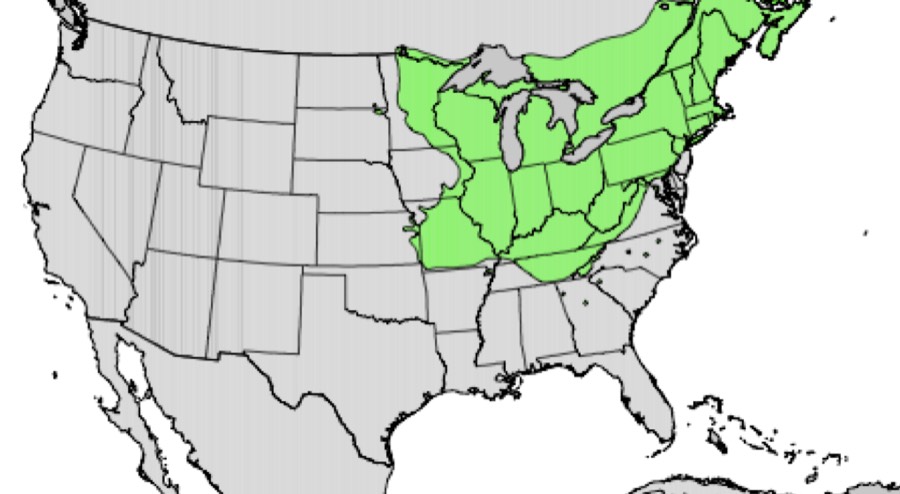
Sources: USDA Forest Service, Fire Effects Information System: Little's range maps ↗ (opens in a new tab), US Forest Service, Fire Effects Information System: sugar maple ↗ (opens in a new tab)
The sugar maple, in short
- Size
- Usually 90 to 120 feet tall with a trunk 30 to 36 inches across; the biggest pass 130 feet and 5 feet across.
- Lifespan
- Long-lived: trees can reach 300 to 400 years.
- Bark and fruit
- Light gray to gray-brown, becoming deeply furrowed and rough with age; twigs shiny reddish-brown.
- Where it grows best
- Mostly rich, moist woods, often on stream terraces and in valleys, ravines and sheltered coves, sometimes drier upland woods. Grows best on deep, moist, fertile, well-drained soil; it can't take flooded ground and struggles on dry, shallow soil.
- Shade
- Very shade tolerant: young trees can wait for years under a dense canopy and shoot up fast when a gap opens.
- In spring
- Flowers open 1 to 2 weeks before the leaves; in fall the leaves usually drop just after the seeds.
- Wildlife
- White-tailed deer, moose and snowshoe hares browse it. Red, gray and flying squirrels eat its seeds, buds, twigs and leaves, and porcupines eat the bark. Many songbirds nest in it; cavity nesters such as the black-capped chickadee use its holes.
- People and uses
- The main source of maple syrup and maple sugar, which many Native American peoples also traded. Widely planted as a shade tree.
Source: US Forest Service, Fire Effects Information System: sugar maple ↗ (opens in a new tab)
Where to see sugar maples in fall
- Katahdin Woods and Waters · MaineSep 1–Oct 15
- Voyageurs · MinnesotaSep 11–20
- Chippewa National Forest · MinnesotaUsually Sep 17–30
- Mississippi River, Minneapolis–St. Paul · MinnesotaUsually Sep 24–Oct 7
- Aroostook Refuge · MaineUsually Oct 1–10
- Blue Ridge Parkway · North CarolinaUsually Oct 1–31
- Cumberland Gap · KentuckyOct 1–31
- Great Smoky Mountains · TennesseeUsually Oct 1–Nov 10
- Iroquois Refuge · New YorkOct 1–10
- Crawford Notch and Zealand Valley · New HampshireOct 4–10
- White Mountain National Forest · New HampshireOct 4–10
- Pinkham Notch · New HampshireOct 4–10
States: Massachusetts · New Hampshire · Maine · Tennessee · Kentucky · North Carolina · New York · Maryland · New Jersey · Wisconsin · Minnesota
Questions people ask
When do sugar maples turn?
It depends on the region. In a typical fall they are most colorful first in the Upper Midwest (week of Oct 6) and last in the Mid-Atlantic (week of Oct 27), from USA-NPN volunteer observations.
Do sugar maples turn early or late compared with other trees?
In New England, number 4 of 10 trees to start coloring; In the Southern Appalachians, number 7 of 10 trees to start coloring; In the Mid-Atlantic, number 5 of 10 trees to start coloring; In the Upper Midwest, number 3 of 10 trees to start coloring.
Are sugar maples ahead or behind this fall?
In New England, for Sep 15–21: 0% of observations with half the leaves colored, against 3% in a typical year (about the same).