When do paper birchesturn?
When do paper birches change color?
The Upper Midwest sees paper birches at their most colorful first, around Oct 13–19; New England last, around Oct 20–26, 1 week later (USA-NPN, 2020–2025).
One tree, several regions
Sep 1 to Nov 30; darker = more paper birches half colored.
Paper birches this fall
- The Upper Midwest about typical: 4% vs 2% (24 obs.)
How to recognize it
Its fall color. Soft gold.
Leaf drawing: ours, simplified.
Sources: US Forest Service, Fall Colors ↗ (opens in a new tab), US Forest Service, Fire Effects Information System: paper birch ↗ (opens in a new tab)
Look-alikes How to tell them apart (US Forest Service)
Paper birch's mature bark is white and smooth and peels off in papery sheets; yellow birch's is slightly shiny, peels in thin layers for a finely shaggy look, and is deeply grooved on old trunks. Paper birch is short-lived (few pass 140 years) and needs full sun, while yellow birch averages about 150 years, can pass 300, and tolerates some shade.
Paper birch's mature bark is white and peels in sheets; river birch's splits into thin papery scales, coarser low on the trunk. River birch keeps to floodplains, stream banks and sandbars, while paper birch reaches the Arctic tree line and grows on almost any soil.
When do river birches turn? →Sources: US Forest Service, Fire Effects Information System: paper birch ↗ (opens in a new tab), US Forest Service, Fire Effects Information System: yellow birch ↗ (opens in a new tab), US Forest Service, Fire Effects Information System: river birch ↗ (opens in a new tab)
Where it grows
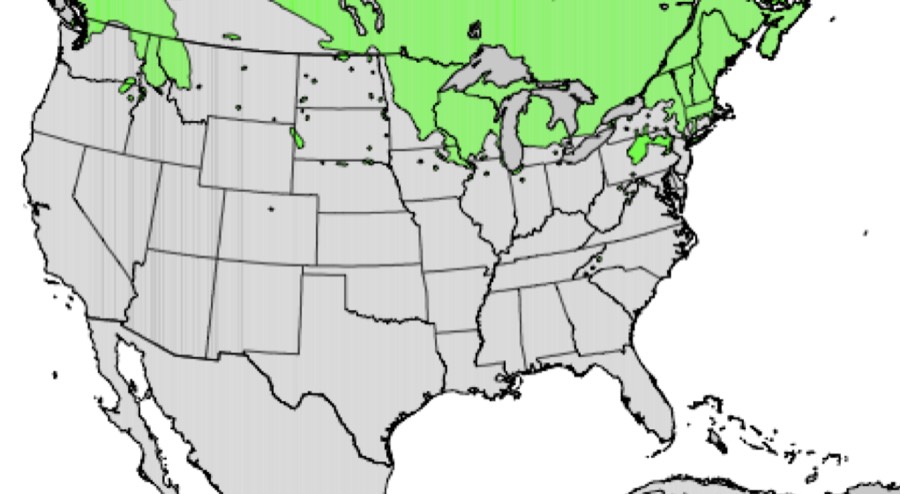
Sources: USDA Forest Service, Fire Effects Information System: Little's range maps ↗ (opens in a new tab), US Forest Service, Fire Effects Information System: paper birch ↗ (opens in a new tab)
The paper birch, in short
- Size
- Mature trees are usually 70 to 80 feet tall with trunks 10 to 12 inches across, now and then up to 30 inches. In Alaska they are smaller, commonly 20 to 60 feet.
- Lifespan
- Short-lived: it stops growing taller at about 60 to 70 years, and few trees live past 140.
- Bark and fruit
- Reddish-brown on young trees. On mature trees it is thin, white and smooth, often splitting into papery strips that peel off in sheets.
- Where it grows best
- From the northern limit of trees in arctic Canada and Alaska through the boreal forest to the mixed forests of the Northeast and Lake States. In the mountains of New England and New York it is one of the few hardwoods near timberline. It grows on almost any soil, best on deep, well-drained sandy or silty ground.
- Shade
- Needs sun: a pioneer that fills burned and logged land, often in pure stands, then lasts only one generation before shade-tolerant conifers or northern hardwoods take over.
- Wildlife
- One of the five most important moose foods in the East. Deer eat its leaves in fall, snowshoe hares browse the young trees, and porcupines and beavers feed on it. Redpolls, siskins and chickadees get a good share of their year's food from birch seeds, and ruffed grouse eat the catkins and buds. Yellow-bellied sapsuckers drill it for sap, and hummingbirds and red squirrels feed at the sap wells.
- People and uses
- Native Americans made its bark into canoes, baskets, containers, torches and more. The sap can be made into syrup, wine and beer. A popular landscape tree for its bark and graceful shape.
Source: US Forest Service, Fire Effects Information System: paper birch ↗ (opens in a new tab)
Where to see paper birches in fall
- Katahdin Woods and Waters · MaineSep 1–Oct 15
- Voyageurs · MinnesotaSep 11–20
- Chippewa National Forest · MinnesotaUsually Sep 17–30
- Hiawatha National Forest · MichiganSep 21–30
- Mississippi River, Minneapolis–St. Paul · MinnesotaUsually Sep 24–Oct 7
- Pictured Rocks · MichiganUsually Sep 24–Oct 10
- Aroostook Refuge · MaineUsually Oct 1–10
- Au Sable River · MichiganOct 1–31
- Crawford Notch and Zealand Valley · New HampshireOct 4–10
- White Mountain National Forest · New HampshireOct 4–10
- Pinkham Notch · New HampshireOct 4–10
- Waterville Valley · New HampshireOct 4–10
States: Massachusetts · New Hampshire · Maine · Minnesota · Wisconsin · Michigan
Questions people ask
When do paper birches turn?
It depends on the region. In a typical fall they are most colorful first in the Upper Midwest (week of Oct 13) and last in New England (week of Oct 20), from USA-NPN volunteer observations.
Do paper birches turn early or late compared with other trees?
In New England, number 7 of 10 trees to start coloring; In the Upper Midwest, number 4 of 10 trees to start coloring.
Are paper birches ahead or behind this fall?
In the Upper Midwest, for Sep 15–21: 4% of observations with half the leaves colored, against 2% in a typical year (about the same).